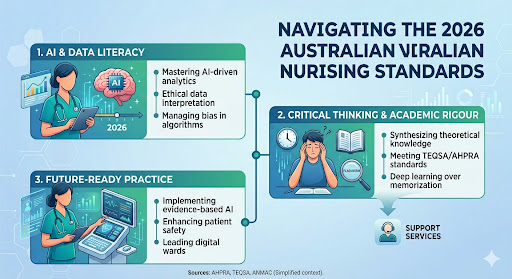
The Australian healthcare landscape is standing on the precipice of its most significant technological evolution since the introduction of electronic health records. Artificial Intelligence (AI) is no longer a futuristic concept discussed only in research niches; it is rapidly integrating into frontline clinical practice. From predictive analytics reducing patient deterioration in hospitals like The Alfred in Melbourne, to AI-driven diagnostic tools assisting GPs in rural Queensland, the digital transformation is here. This shift, however, brings a complex challenge: ensuring the next generation of Australian nurses is competent in managing these technologies while upholding the highest standards of care and academic rigour.
As we approach 2026, the Australian Nursing and Midwifery Accreditation Council (ANMAC) and the Tertiary Education Quality and Standards Agency (TEQSA) are finalizing updated competency standards. These new benchmarks demand a high degree of digital literacy, a thorough understanding of data ethics, and the ability to critically evaluate AI-generated care suggestions. For current nursing students across the country, this adds a substantial layer of complexity to an already rigorous curriculum. Managing clinical placements alongside these advanced theoretical modules is a significant burden. When facing these compounding pressures, many students are forced to ask, “who can safely and ethically do my assignment for me in Australia?” as they struggle to maintain their required Grade Point Average (GPA) without compromising deep learning.
The 2026 Shift: Beyond Basic Digital Literacy
The upcoming 2026 standards do not merely require nurses to use a computer; they mandate that graduates demonstrate cognitive fluency in digital health ecosystems. Future nurses must understand algorithmic bias, privacy regulations specific to Australian digital health records (like the ‘My Health Record’ system), and the potential legal implications of relying on automated clinical decision support. This evolution reflects the growing complexity of the field, where a nurse might be managing a virtual ward or interpreting data from wearable remote monitoring devices. The curriculum now requires sophisticated critical analysis, moving away from rotelearning toward high-level synthesis of complex data sets.
The Integrity Crisis: Balancing Support and Ethics
This pressure creates a significant challenge for academic integrity. The rise of generative AI tools (like ChatGPT) offers students a tempting shortcut. However, TEQSA has been clear: the undetected use of generative AI to produce academic work is contract cheating. Universities are deploying increasingly sophisticated AI detection tools (like Turnitin’s AI writing detector) to maintain the value of their qualifications. For a nursing student, getting caught using AI unethically can result in immediate failure or even expulsion, permanently derailing their career.
The ethical dilemma is clear: students need high-level, human support to understand these complex new subjects, but they must also guarantee that the work they submit is their own critical synthesis. This is where specialized professional guidance becomes crucial. Rather than relying on automated tools, many students seek ethical mentoring. Services that provide nursing assignment help through human experts—who themselves are often AHPRA-registered educators or Senior Content Writers in academia—offer a compliant path. These experts provide model frameworks, help students break down complex rubrics, and provide critical feedback, enabling the student to produce original, high-integrity work.
Conclusion
By 2026, the successful Australian nurse will be a hybrid professional: a compassionate caregiver and a sophisticated data analyst. The journey to reaching that competency is arduous, but it is necessary for patient safety in a digitally transformed aged-care and hospital system. The critical takeaway for current students is that technological fluency cannot replace academic integrity. While seeking human, professional support to navigate this transition is a valid strategy, relying on shortcuts that bypass deep learning will only compromise their ability to practise safely in the future.
Key Takeaways for Australian Nursing Students (2026 Ready)
- ANMAC Competency Shifts: Expect a major focus on AI ethics, digital patient data management, and data-driven clinical decision-making by 2026.
- TEQSA Strictness: Plagiarism and contract cheating (including unapproved AI use) will be met with zero tolerance as Australian universities protect the integrity of the AQF framework.
- The Power of Critical Thinking: AI tools can provide information, but the 2026 standards reward the ability to critically analyze and synthesize that information into original thought.
- Valid Support Structures: Utilizing expert human mentoring and framework-based assistance is an ethical way to manage workload pressure without resorting to automated short-cuts.
See also: Blockchain and Secure Record Keeping
Frequently Asked Questions (FAQ)
1. Will I be expected to code or build AI tools in my nursing degree?
No. The focus is on clinical fluency—understanding how to use, interpret, and ethically manage the output of AI tools to support patient care, not on technical development.
2. Are Australian universities banning all AI in assignments?
No, but usage policies vary strictly between institutions. Most prohibit using AI to generate the substance of an assignment, but may allow it for brainstorming or structure, provided it is explicitly cited. Always check your unit outline.
3. Is getting professional mentoring for my essays considered academic misconduct in Australia?
Seeking guidance from human mentors who provide model answers, tutoring, or structural feedback is allowed, provided you use that assistance to create your own original work. Services that guarantee customized, un-plagiarized guidance from experts serve this exact purpose ethically. Passing off their guidance as your own analysis, however, is not allowed.
4. What happens if I make a clinical decision based on faulty AI data?
Under AHPRA regulations, clinical judgment always rests with the human practitioner. Nurses are expected to understand the limitations of digital tools and prioritize their critical assessment over automated advice if discrepancies arise.
Author Bio
This article was contributed by Lachlan Miller, a Senior Academic Strategist in the Nursing and Allied Health Division at MyAssignmentHelp.Services. With over a decade of experience in Australian higher education and a background in clinical curriculum development, Lachlan specialises in helping students navigate the complexities of TEQSA compliance and the evolving AQF standards. Our authors are dedicated former clinicians and educators who provide compliant, high-level mentoring to students across Australia, helping them meet rigorous academic standards ethically. For detailed, human-guided support with your modern care modules, explore our specialized services.
References
- Australian Nursing and Midwifery Accreditation Council (ANMAC). (2024). Consultation on Updated Registered Nurse Accreditation Standards for 2026. Canberra: ANMAC.
- Tertiary Education Quality and Standards Agency (TEQSA). (2024). Artificial Intelligence: Challenges and Opportunities for Academic Integrity. Melbourne: TEQSA.
- Australian Institute of Health and Welfare (AIHW). (2023). Digital Health in Australia: Statistics and Trends. Canberra: AIHW.